**Interactive Projection Mapping in Events**
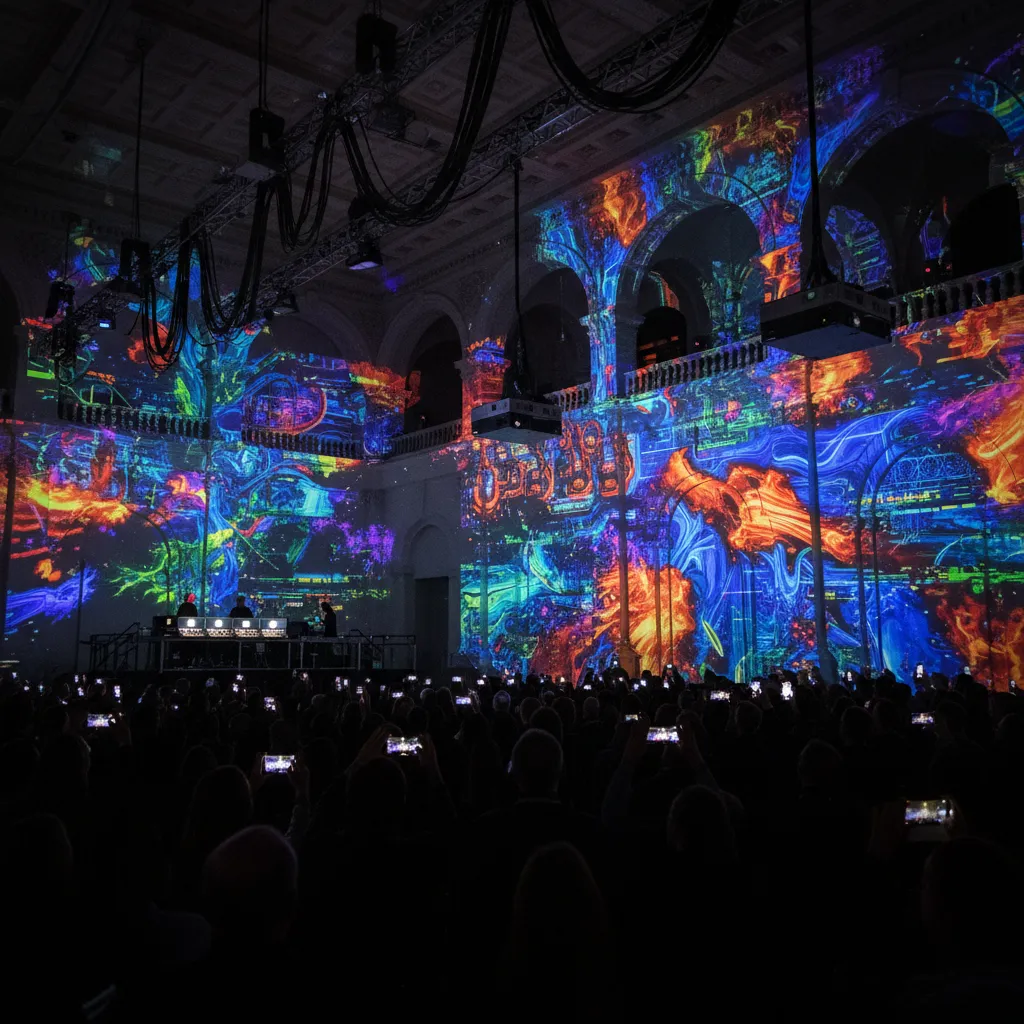
Interactive projection mapping is one of the most immersive and technologically sophisticated forms of experiential design available to modern event producers. At its core, it is the art and science of projecting precisely calibrated digital imagery onto three-dimensional surfaces — architecture, sculptures, stages, vehicles, even entire building facades — so that the light conforms perfectly to every contour, curve, and edge of the physical world beneath it. But when interactivity is layered on top, the experience transforms from passive spectacle into something far more powerful: a living, breathing environment that responds to the people inside it.
What It Is
Traditional projection mapping turns any surface into a canvas. Interactive projection mapping goes several steps further by connecting that canvas to real-time data inputs — motion sensors, touch pads, sound frequencies, crowd movement, social media feeds, or even biometric signals. The result is a display that doesn't just play out a pre-rendered sequence, but actively listens, reacts, and evolves based on what is happening in the room at any given moment.
When a guest waves their hand, the wall ripples. When the crowd cheers, the ceiling erupts in color. When a speaker takes the stage, the entire environment shifts its mood, palette, and energy in a coordinated instant. The boundary between audience and artwork dissolves completely.
The Technology Behind It
At the technical level, interactive projection mapping is a fusion of several disciplines:
- **Projection hardware** — High-lumen projectors (often ranging from 10,000 to 60,000+ lumens for large venues) are carefully rigged and angled to cover the target surface without spill or distortion.
- **Mapping software** — Platforms like Resolume, Derivative TouchDesigner, MadMapper, or Disguise (d3) allow operators to warp, blend, and mask projection layers so they align precisely with the physical geometry of the surface.
- **Sensor integration** — Depth cameras (such as Intel RealSense or Microsoft Azure Kinect), infrared sensors, LIDAR scanners, and microphones capture real-time environmental data — tracking body positions, gestures, sound levels, and spatial movement.
- **Real-time rendering engines** — Game engines like Unreal Engine or custom GPU pipelines process incoming sensor data and generate visual responses in milliseconds, ensuring that the interaction feels instantaneous and fluid rather than delayed or mechanical.
- **Media servers** — High-performance media servers act as the nervous system of the installation, synchronizing multiple projectors, managing data streams, and orchestrating timed lighting, audio, and video cues into a seamless whole.
Applications in Events
Interactive projection mapping has found a home across virtually every category of live event:
**Corporate Events & Brand Activations**
Brands use interactive projection mapping to create unforgettable product launches and experiential marketing moments. A car manufacturer might unveil a new model by projecting its design evolution across a sculpted stage surface that physically matches the vehicle's silhouette. Guests touching a display table might trigger animations that travel across the walls. The product becomes part of a living story rather than a static centerpiece.
**Concerts & Music Festivals**
Artists and production designers use interactive mapping to synchronize visuals with live audio in real time. Beat detection algorithms trigger visual bursts, camera tracking follows performers across the stage, and reactive environments shift with the emotional arc of a set — from intimate and hazy to explosive and kinetic — all without a single pre-rendered moment.
**Galas, Award Shows & Ceremonies**
Projection mapping elevates the theatrical quality of formal events, turning ballrooms and arenas into dynamic storytelling spaces. Award reveals, historical retrospectives, and sponsor showcases can unfold throughout the room's architecture, creating moments that are impossible to replicate on a flat screen.
**Trade Shows & Exhibitions**
Exhibition stands and product showrooms use interactive floor and wall projections to draw foot traffic and extend dwell time. Visitors walking across an illuminated floor might trigger product information panels on the walls, or manipulate a 3D data visualization simply by gesturing in the air.
**Weddings & Private Celebrations**
Luxury event designers are increasingly bringing projection mapping into private celebrations — transforming venue walls with personalized animations, lighting dance floors with reactive visuals, and creating one-of-a-kind moments that guests remember for a lifetime.
**Museums, Theme Parks & Installations**
Though not strictly events in the traditional sense, permanent and temporary interactive projection installations in public and cultural spaces have profoundly influenced the event industry, pushing the creative and technical limits of what is possible and raising audience expectations with every iteration.
---
**Why It Works: The Psychology of Immersion**
Interactive projection mapping succeeds because it taps into something deeply human — the desire to be seen, to have agency, and to be part of something larger than oneself. When an environment responds to your presence, you stop being a spectator and become a participant. That shift in role fundamentally changes the emotional experience of an event.
Research in experiential design consistently shows that active engagement produces stronger emotional memories than passive observation. A guest who triggered a spectacular visual moment with their own movement will remember that event far more vividly — and share it far more enthusiastically — than one who simply watched a pre-recorded light show.
This makes interactive projection mapping not just an aesthetic choice, but a strategic one for event producers aiming to drive Projection Mapping Prices social sharing, brand recall, and emotional impact.
---
**Design Considerations**
Executing interactive projection mapping at a professional level requires meticulous planning:
- **Surface geometry** must be surveyed and modeled digitally in advance so that content can be designed to fit precisely.
- **Ambient light control** is critical — even small amounts of competing light can wash out the projection, so venue lighting design must work in concert with the mapping system.
- **Latency management** ensures that interactive responses feel instantaneous — any lag greater than 80–100 milliseconds is perceptible and breaks the illusion.
- **Content design** must account for the three-dimensional nature of the surface — flat graphic design sensibilities don't translate directly and can look distorted or flat when projected onto complex geometry.
- **Fallback systems** are essential in live event environments where a single point of failure can affect thousands of guests simultaneously.
---
**The Future of the Medium**
As LED volumes, AI-driven content generation, augmented reality overlays, and real-time generative systems continue to mature, interactive projection mapping is evolving rapidly. AI tools now allow content to adapt not just to physical triggers, but to emotional analysis of crowd sentiment, weather data, social media activity, and brand messaging parameters — creating events that are genuinely intelligent environments rather than scripted performances.
For event producers, AV designers, and brand experience architects, interactive projection mapping represents the current pinnacle of live environment design — a technology that turns architecture into storytelling, space into emotion, and audiences into co-creators of the moments they will never forget.